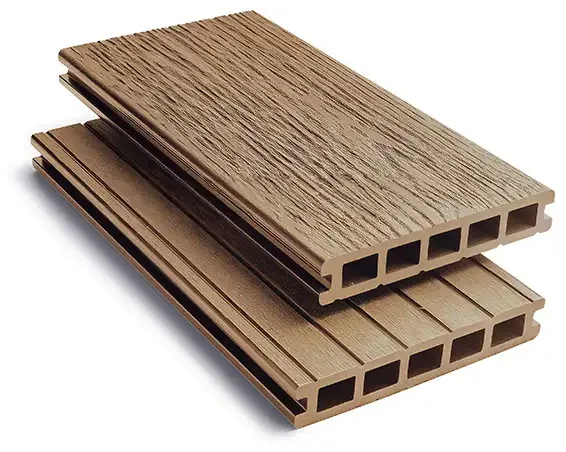
Deciding between WPC decking and wood decking for a Spanish terrace or balcony? This is one of the most common questions buyers across the Mediterranean ask us. Spanish summers, salty coastal air, rainy winters and occasional frosts are tough on timber, and the wrong choice means years of staining, sanding and rot. Below we compare WPC decking vs wood decking across the factors that matter most to Spanish and European buyers.
Why the Mediterranean Climate Is Hard on Wood
Natural wood in Spain faces a punishing cycle: humid winters swell the fibres, baking summers dry them out and split them, and strong UV light turns golden oak to grey within a couple of seasons. Near the coast, salt air accelerates corrosion of fixings and darkens the surface. In warmer inland provinces, termites and wood-boring insects silently attack untreated boards. Every year, the customer pays again to oil, sand and replace the floor.
Head-to-Head Comparison
| Factor | Natural Wood | WPC Decking |
|---|---|---|
| Water & moisture | Rots, swells, warps | Waterproof, dimensionally stable |
| Termites & insects | Attacked | Resistant |
| Maintenance | Oil or stain every 1–2 years | Sweep and hose, no coating |
| Lifespan | 8–12 years with care | 15+ years under normal use |
| Anti-slip | Fades and needs treatment | Textured, slip-resistant when wet |
| Cost over lifecycle | High | Low |
Total Cost of Ownership
Wood often looks cheaper at the counter, but the real price arrives with every maintenance season. Sanding, oils, replacement boards and the labour of a scaffolded terrace add up. WPC decking costs more per square metre on day one, but after a decade of zero upkeep it is almost always the cheaper choice — which is why distributors across Spain and the Canary Islands now stock it as their standard terrace floor.
When Wood Still Makes Sense
Solid wood still wins for bespoke artisan projects where the client wants genuine timber grain you can feel, or for temporary structures. For everything else — balconies, rooftop terraces, pool surrounds, garden walkways and commercial outdoor areas — WPC is the practical, low-risk choice.
For Spanish B2B buyers, the combination of factory-direct pricing, a 15-year service life and almost no maintenance makes WPC the default. If you are planning a project, check our step-by-step balcony guide and our factory-direct sourcing page.
What Spanish Buyers Usually Ask Us
First, the price: WPC boards cost more than pine or pressure-treated timber, but usually less than imported hardwood. Second, colour: most buyers choose grey or walnut, because very dark tones heat up under strong sun and medium greys age best over time. Third, installation: WPC goes down on the same joist frame as timber, so your usual installer can fit it without new skills. Fourth, recycling: at the end of life, composite boards can be recycled rather than sent to landfill. And fifth, warranty: a reputable factory supports a service life of at least 15 years. Taken together, these answers explain why Mediterranean contractors now quote WPC as their default terrace floor — and why the cheapest timber quote is rarely the cheapest one.
Related Products
3D Embossed Classic Wood Grain WPC Decking
146*25mm Deep Embossed Anti-Water WPC Decking
140S23 Co-Extrusion WPC Decking
Related Articles
Installing WPC Decking on a Concrete Balcony: Step-by-Step Guide
WPC Decking Supplier Spain: Factory-Direct Sourcing Guide
Need a Quote for "WPC Decking vs Wood Decking: What Spanish Buyers Must Know"?
Factory Direct · OEM/ODM Customization · FCL / LCL · At Least 15 Years. Contact us on WhatsApp for an instant quote.